Dials & hands
Indices, contrast, and hand lines
Dial architecture — chapter rings, applied indices, printed tracks, and handset counterweights — governs how quickly you parse hour and minute at a glance.
Index styles
- Applied faceted — Metal markers catch directed light; depth via bevels.
- Printed or transferred — Flat color blocks; crisp under flat studio light.
- Arabic or Roman — Numerals add character; may reduce at-a-glance parsing.
- Baton & wedge — Minimal geometry; pairs with syringe or pencil hands.
Lume as design
Photoluminescent compound fills plots or handset centers for low-light readability. Hue after charging — green, blue, or mint — is a deliberate material choice that shapes night-time character as much as daytime contrast.
Lume hue
Sandwich dial
Fauxtina patina
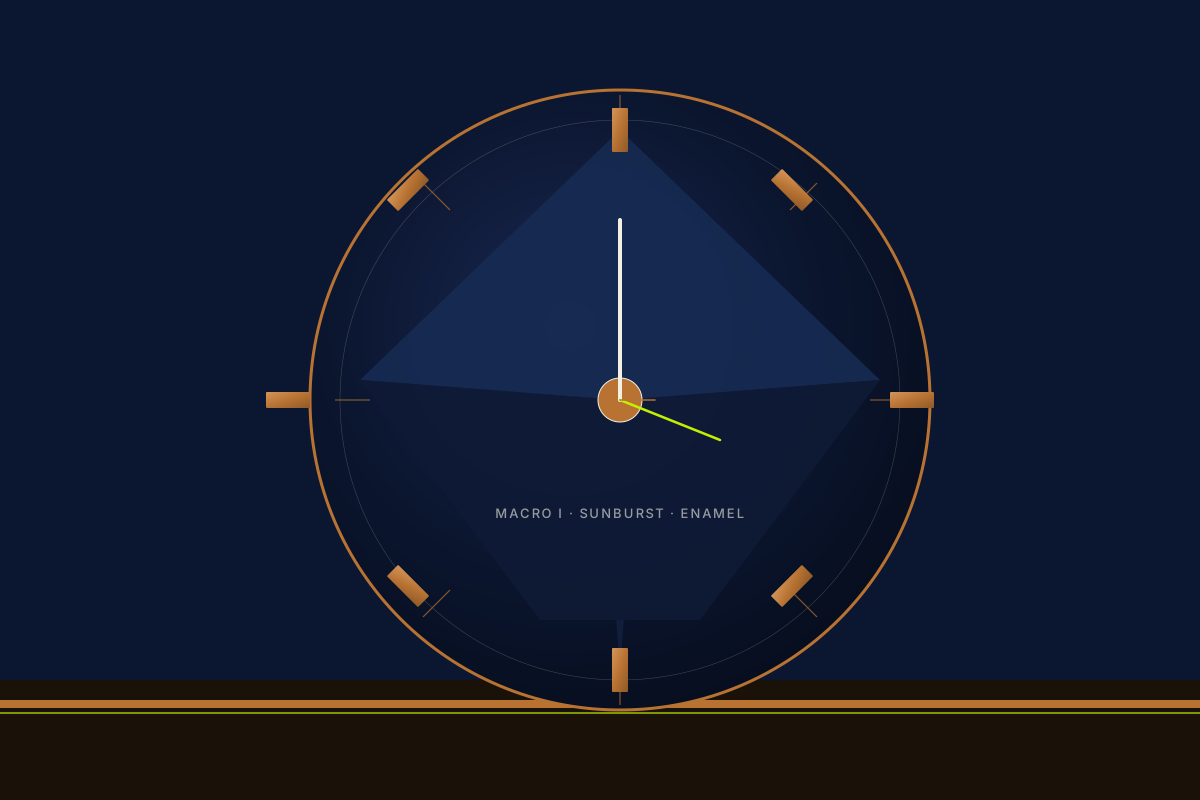
Hand shapes
Dauphine, syringe, baton, and cathedral profiles change weight at the tip. A long minute hand with a short hour counterweight balances photography crops differently than equal-length batons.