Quartz
Battery rhythm and dial clarity
A quartz crystal oscillates at a stable frequency; circuitry divides that signal to drive a stepping motor that moves the hands — steady, legible, and often thin on the wrist.
Movement basics
- Quartz resonator — A tiny crystal vibrates when electrified; frequency defines timekeeping.
- Integrated circuit — Counts oscillations and pulses the motor at fixed intervals.
- Step motor — Advances gears in discrete steps — once per second is common.
- Battery cell — Silver-oxide or lithium coin cells supply low, steady voltage.
Design and legibility
High-contrast indices, generous handset scale, and matte dial surfaces reduce glare under office light or street lamps. Date windows trade symmetry for utility.
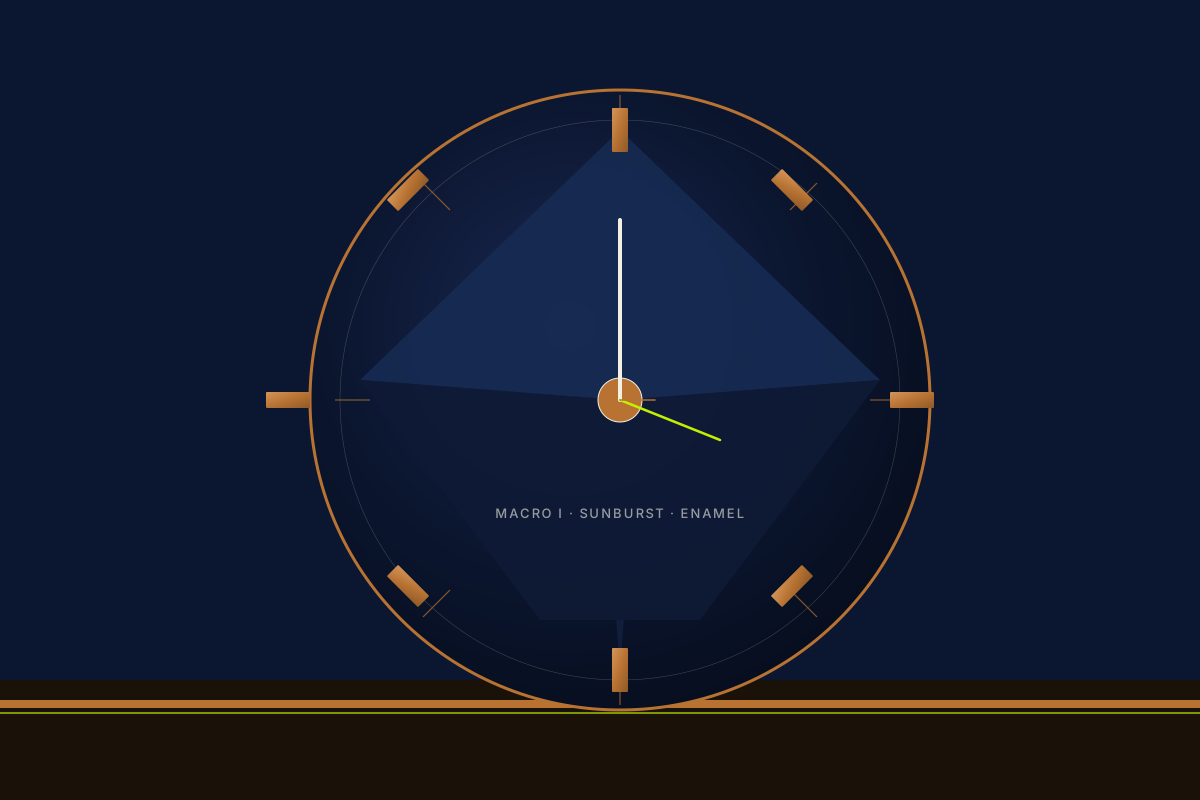
Second hand behavior
A dead-beat second clicks once per second; some designs use a glide motion for a softer sweep. The difference is mostly visual — how calm or lively the dial feels at a glance.
High contrast
Matte dial
Step seconds
Hybrid context
Spring-drive and kinetic concepts blend mechanical mainspring storage with electronic regulation — hybrids worth understanding when you compare motion on the wrist to pure mechanical or quartz designs.