Mechanical
Movement families and visible mechanics
Mechanical timekeeping stores energy in a mainspring, releases it through a gear train, and regulates it with a balance and escapement — rhythm you can sometimes see through a display back.
Common movement families
- Manual winding — Crown tension feeds the mainspring; no rotor; tactile ritual of daily wind.
- Automatic — A rotor follows wrist motion to wind the mainspring through reduction gears.
- Hand-wound with power reserve — A dial or caseback indicator shows remaining mainspring torque.
- Micro-rotor — Compact winding mass tucked within the movement plates for slimmer cases.
Escapement and balance
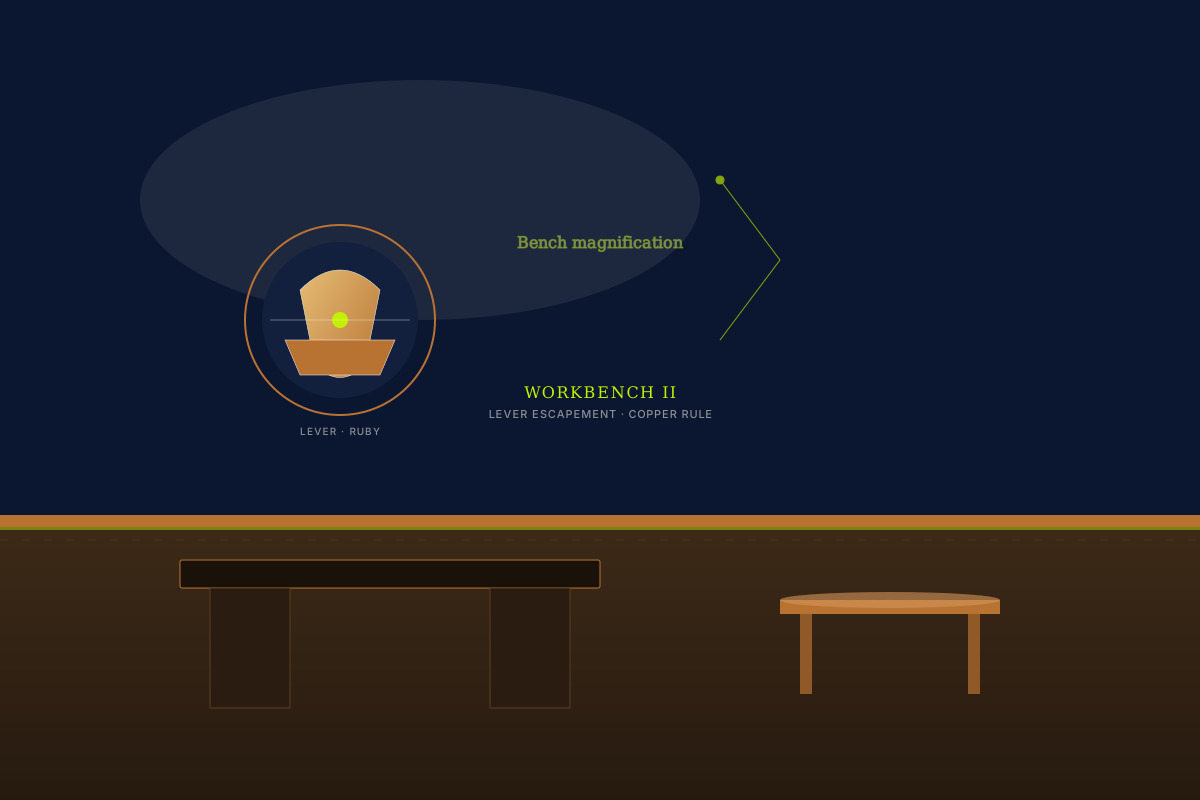
The escapement converts the gear train's steady pressure into the balance's oscillation — each tick is a locked impulse followed by a brief free swing.
Visible components
- Crown wheel & ratchet — Transfer winding to the mainspring barrel.
- Barrel & arbor — Store elastic energy as the spring coils.
- Center wheel — Drives the minute hand at a fixed reduction.
- Fourth & escape wheels — Step down torque to the pallets.
Frequency and finishing
Beat rates such as 18,000, 21,600, or 28,800 vibrations per hour change how the second hand glides or steps. Anglage, perlage, and Geneva stripes reward the eye under magnification; on the wrist they read as texture and depth.